




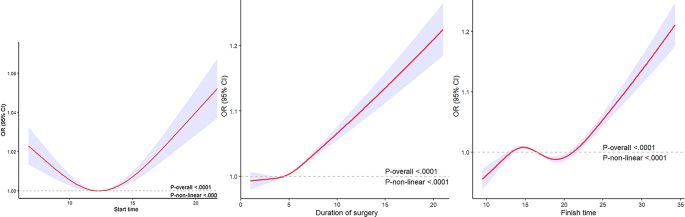
In this study, we found a detrimental association between surgical start time, duration and outcomes. Our findings highlighted the gradually increased risk of adverse surgical outcomes with a delay in the start time and prolonged duration of the operation. Moreover, the association between the duration of the operation and surgical outcomes is moderated by the surgical start time. The detrimental association between a later completion time and surgical outcomes may be caused by the longer duration of the operation.
In the last decade, several researchers have reported a detrimental association between starting and completing off-work and longer durations of surgery and surgical outcomes10,14,17. Kelz and colleagues7 reported that operations starting after 4 PM were associated with an elevated risk of morbidity (OR = 1.25, P ≤ 0.005) compared with those starting between 7 AM and 4 PM. In another retrospective study conducted by Joseph R11the author reported that patients whose neurosurgery (including emergency and routine surgeries) started between 21:01 and 07:00 were at increased risk of developing morbidity compared with patients whose surgery started earlier in the day (OR = 1.53, P = 0.04). Operative duration was the strongest predictor of postoperative morbidity, and most studies have indicated inferior outcomes with prolonged symptom duration18,19,20. Furthermore, some surgeons have indicated that off-hour work is a risk factor for surgical outcomes. In our study, we found a nonlinear association of RCS with the surgical start time and duration with outcomes, and the reason for adverse surgical outcomes caused by off-work time was the duration of the operation, a phenomenon not observed in the previous study. Moreover, the subgroup analysis of time variables and interaction analysis further revealed associations between surgical results and different periods.
However, some researchers reported that21 in a study in which propensity score matching was used, the postoperative complication rates were similar between the morning surgery and afternoon surgery groups (all P ≥ 0.05). In a retrospective study by Brah et al.22there was no association between an increase in perioperative adverse events or mortality and surgical start time. This inconsistency is attributed to differences in professional judgement and self-regulation by experienced physicians23,24. This association was not possible because of insufficient statistical power, a lack of sufficient surgery by different surgeons and diverse outcome measures of surgical quality. Our study has substantially greater statistical power because of its much larger size and utilized the generalized linear mixed model to adjust for surgical type and physical fixed effects. We considered unplanned reoperation and mortality as surgical outcomes for the assessment of surgical quality. To avoid the influence of patient condition and other factors, emergency procedures were also excluded. To influence the rate of loss to follow-up, we collected data on unplanned reoperations and deaths during hospitalization.
Comparisons of patient features were performed on the basis of differences in surgical outcomes, start times and durations. There was no difference in patient characteristics. These findings are unlikely to be explained by differences in patients, surgical types and surgeon factors. Taken together, these findings suggest that the performance of surgeons might be affected by factors that are not directly related to surgical type or the features of patients and professional experienced physicians. In a previous study, some surgeons reported that surgical results, such as fatigue and distractions, are affected by negative conditions14,25. However, there is insufficient evidence to directly indicate that poor surgical outcomes are attributed primarily to surgeon fatigue10,14.
In a previous study, Eric C Sun et al.26. reported that there was no difference in surgical outcomes when a surgeon operated on the night before. It seems that fatigue does not affect outcomes. However, the greater impact of continued longer-duration work may be ignored. In our study, there was a significant difference when the intermission work time was greater than 10 h. Mannel et al.27 reported that prolonged surgery increased fatigue in surgeons and led to worse surgical results. Moreover, Karaca et al.28. reported that decreased patency rates were caused by increased operator fatigue in microvascular anastomoses. Direct identification of the associations between fatigue and adverse surgical outcomes is difficult. In our study, we utilized interaction analysis and reported that when the duration of the operation was shorter and the surgery started earlier, the ORs of adverse events significantly decreased. Although other factors are excluded and fatigue may be a reasonable and appropriate explanation, there is a lack of direct evidence to demonstrate it (as fatigue cannot be quantified). We found that longer surgical durations commonly start at an earlier period for initial placement. This finding suggests that some surgeons may consider fatigued factors, which supports the credibility of our study and explains why surgeries started at 13:00 have the lowest risk of adverse outcomes.
Limitations of this study
This study had several limitations. First, although we adjusted for a broad set of patient-level confounders, we could not eliminate the possibility of unmeasured confounding. Second, we focused on common neurosurgical procedures; therefore, the findings might not be generalizable to other surgical procedures. Third, the potential confounding effects of case complexity and variations in intraoperative staffing (e.g., anaesthesiology, nursing) were not considered in the model. Fourth, although, under some conditions, unplanned reoperation and mortality may be similar, the two results, as a composite, may limit this research to some degree. Fifth, due to limitations in terms of methods and data, some results of surgical types and surgeons may be more dependent on the start time and duration, and we lack direct evidence to identify them.
link
More Stories
Median Arcuate Ligament Syndrome | Orlando surgeon explains signs, symptoms and treatment
Gyder Surgical announces first commercial surgical cases in the United States performed by Dr. Paul M. Lombardi, M.D., at the Tri-County Orthopedics’ Joint Replacement Institute outpatient center
Bunion Surgery Market Get Facts About Business Strategies 2026 to 2031: Medi-tech Insights