





NASHVILLE, Tenn. (WSMV) – A report released Monday says that Tennessee has some of the worst infant and maternal death rates in the country.
March of Dimes said that the U.S. is not doing enough to protect mothers and newborns. The group’s annual report card gave the country a D+, calling pre-term birth rates a crisis in the country.
Tennessee scored worse than the US, with a D- score for its pre-term birth rate. The Volunteer State also ranked last for its maternal mortality and scored in the bottom half of states for most categories.
The annual report card from March of Dimes, a group supporting research, education and advocacy for moms and babies, was released on Monday in recognition of World Prematurity Day. The nonprofit said it “measures the state of maternal and infant health in the US by evaluating preterm birth rates, access to maternity care, and other key indicators of maternal and infant well-being across all 50 states, Washington, D.C., and Puerto Rico.”
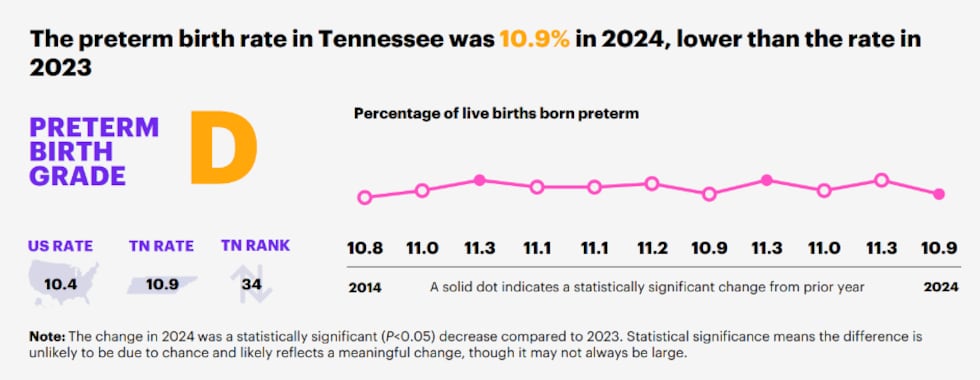

This is the third year in a row that the U.S. scored a D+. March of Dimes told CNN that 380,000 babies were born too soon in 2024, meaning one in every 10 births.
“As a clinician who has seen how much is possible when we get it right, the data is deeply frustrating,” said Dr. Michael Warren, March of Dimes Chief Medical and Health Officer. “That the national rate remains unchanged while disparities continue to widen means we must deepen our commitment to research, expand maternity care access and push for better policies that protect our nation’s moms and babies.”
Dr. Warren previously worked in leadership at health organizations including the Associate Administrator of the Maternal and Child Health Bureau at the Health Resources and Services Administration (HRSA) and the Tennessee Department of Health.
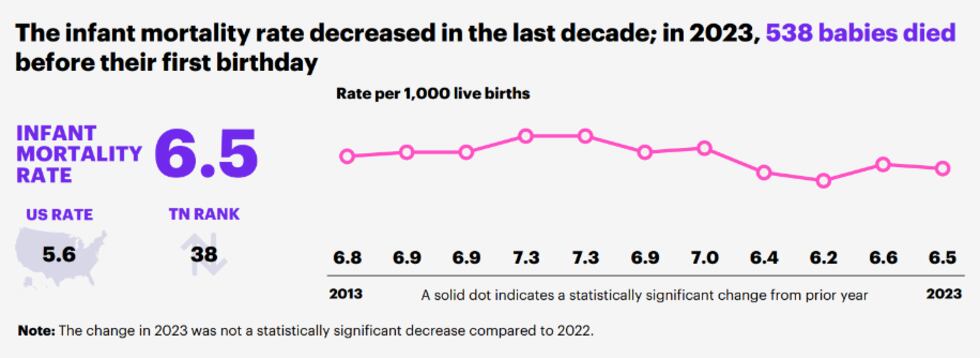
Additionally, the report found the infant mortality rate at 5.6% nationwide and 6.5% in Tennessee, with over 20,000 U.S. babies dying before their first birthday. According to March of Dimes, the highest rates are reported in the South and Midwest.
Here was Tennessee’s rankings in the following categories provided by March of Dimes:
| Preterm birth | Infant Mortality | Low-risk Cesarean | Adequate Prenatal Care | Severe Maternal Morbidity | Maternal Mortality | |
|---|---|---|---|---|---|---|
| Measure | 10.9% | 6.5 | 25.7% | 74.3% | 91.3 | 42.1 |
| Rank | 34th/52 | 38th/52 | 25th/52 | 37th/52 | 25th/47 | 48th/48 |
| Direction | Improved | Improved | Improved | Improved | Improved | Worsened |
Racial disparities worsen
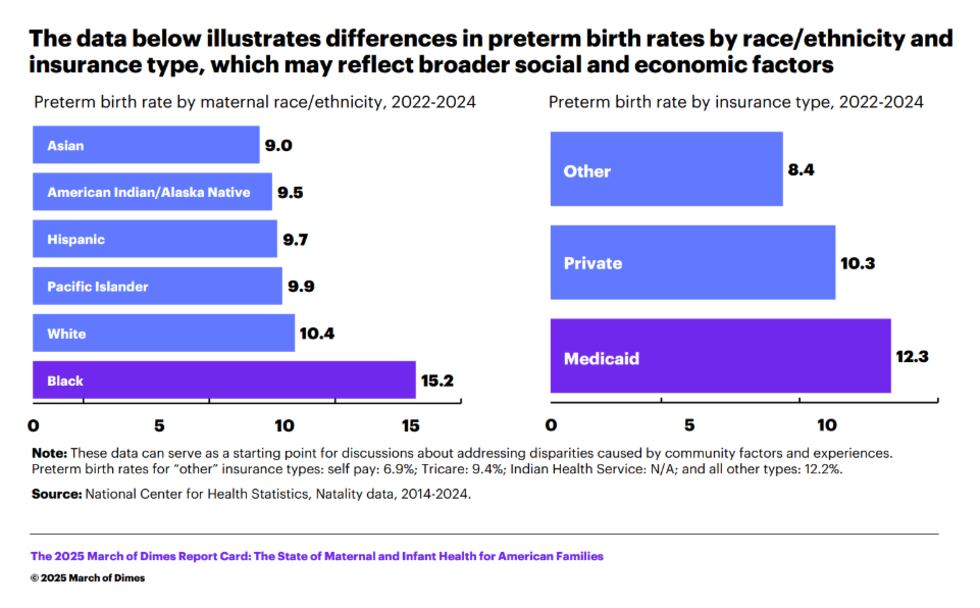
The report also says that racial disparities are getting worse.
Infants born to Black moms are 1.8 times more likely to die than the state average, according to the nonprofit. Mothers who are Black, American Indian, Alaskan native, or pacific islander die at two to three times the rate of white moms.
“How people are treated and experiences like racism and discrimination, and really should be an urgent call for all of us to think about how we improve the quality of health and healthcare in this country,” Dr. Warren told CNN.
The rate of mortality is even higher for mothers.
The Tennessee maternal mortality rate was found to be 42.1 per 100,000, nearly double the national rate of 23.5. March of Dimes said that the rate has declined since its last report card.
The organization reported that racial and ethnic disparities are persistent in that data, too.
What can be done to improve these outcomes?
Despite Tennessee’s low scores, March of Dimes said the Volunteer State has made some progress. The group said the state has made “significant improvements” in low-risk Cesarean births and adequate prenatal care reception.
The organization said that Tennessee has implemented two of the six solutions it recommends to help improve outcomes for moms and infants.
The ones Tennessee has done are:
- Medicaid Extension: State has extended coverage for
- Maternal Mortality Review: State has a maternal mortality review committee to understand causes of deaths, identify preventive factors and recommend changes to improve care and save lives.
But there are also more steps the organization recommends:
- Medicaid Expansion: State adopts a policy that allows for greater access to preventive care before, during and after pregnancy.
- Doula Reimbursement: State Medicaid agency would actively reimburse doula care.
- Paid Family Leave: State would require employers to provide a paid option for families out on parental leave.
- Mental Health: State would require clinicians to screen Medicaid-insured women for postpartum depression during a well-child visit and reimburse for the screening.
Copyright 2025 WSMV. All rights reserved.
link
More Stories
Staff crunch cripples 64 FRUs, raising concerns over maternal and child health
Council seeks way to reduce maternal and infant health disparities
Leaders Prioritise Health Sovereignty and Women’s, Children’s and Adolescents’ Health at the 39th AU Summit