





 Listen to this article
The basics:
- RWJBarnabas Health and SciTech Scity partner to pilot cardiac tech
- FDA-approved cuffless blood pressure patch offers 24-hour monitoring
- BD‘s HemoSphere Alta uses AI for predictive blood flow management
- Rhythmedix and Avertix advance remote monitoring and early detection
Across the Garden State, innovative technology and other organizations are transforming the landscape of cardiac care. One example is a collaboration between RWJBarnabas Health and SciTech Scity – a 30-acre “city of tomorrow” developed by Liberty Science Center in Jersey City – that seeks to fuse third-party entrepreneurial innovation with the knowledge base of a leading academic health system.
The partnership is already producing results, like a cuffless blood pressure patch made by a SciTech Scity-hosted company called Biobeat that RWJBH is currently piloting. Billed as the first Food and Drug Administration-approved cuffless blood pressure patch designed for continuous 24-hour monitoring, the patch is designed “to support more accurate diagnoses and personalized treatment,” said Liberty Science Center President and CEO Paul Hoffman.
“At the core of our mission is a commitment to reimagining health care so it works better for everyone — especially those historically left behind,” noted Michael Prilutsky, executive vice president, CEO of RWJBarnabas Health Medical Group. “These innovative pilots go beyond addressing immediate clinical challenges, such as chronic hypertension and post-discharge care for patients. By supporting scalable, patient-centered solutions, we are helping to close systemic gaps and build a more connected, compassionate, and data-driven future for care delivery. These are not just pilots — they’re the foundation for a new standard in health care.”

Public-private partnerships are crucial for advancing cardiac care, “since they bring together the strengths of both sectors to drive innovation and improve patient outcomes,” added Hoffman. “These collaborations are essential for leveraging resources, expertise and technology to address the complex challenges in cardiac care. By aligning health systems, providers, payers and startups, we can foster innovative approaches that improve patient outcomes and reduce the cost of care.”
He emphasized the importance of focusing on underserved populations, who often face barriers to accessing quality cardiac care. “By coordinating with agencies like the New Jersey Department of Health and the Department of Human Services, we can ensure that digital health solutions reach those who need them most, especially in the face of federal cutbacks,” he noted. “This focus is a key advantage of public-private partnerships, as they can pool resources to address disparities in health care access and outcomes.”
Such partnerships also “provide a neutral test bed for startups to bridge the gap between innovation and clinical practice,” Hoffman explained. “We help entrepreneurs understand how their solutions fit into existing hospital workflows, ensuring that new technologies are seamlessly integrated into patient care. This support is vital for the successful implementation of new technologies, which can ultimately lead to better cardiac and other care for patients.”
“Nobody wants to pay more money for health care,” added Prilutsky. “So, we need to improve quality, safety, efficiency and, importantly, access to health care. Innovation helps to address all of these issues. Injecting businesses into our health care system is a huge move forward, and the State of New Jersey, through the governor’s office and agencies, has been very supportive.”

Working with SciTech Scity to “push the envelope” on remote monitoring, for example, “will help more people – especially underinsured and uninsured – to gain access to early warning systems before a crisis occurs,” he added. “This means they can be connected to skilled cardiologists and other specialists without having to wait until they’re rushed to an emergency room. This effectively increases our ambulatory footprint, from primary care providers to specialists.”
Prilutsky views the partnership with SciTech Scity through a prism of long-term innovation that weaves academia together with health care and business. “Startups have algorithms that can analyze large volumes of health care data and use that to consider an individual’s health situation and gauge like outcomes. At RWJBH, we complement this by leveraging our emergency room data for in-house predictive analysis to help predict critical events. This is the future.”

Gaining leverage

A recently launched hemodynamic – blood flow – monitoring platform developed by Franklin Lakes-based BD (Becton, Dickinson and Co.) is designed to support clinicians in managing blood flow and pressure during operations, potentially improving patient outcomes, according to Dr. (Michael) Monty Mythen, senior vice president, Medical Affairs, BD Advanced Patient Monitoring.
“HemoSphere Alta leverages predictive artificial intelligence-based algorithms that can help doctors proactively address blood pressure instability and optimize blood flow to help avoid potential life-threatening situations during procedures,” he explained. “Significantly, the HemoSphere Alta allows clinicians to continuously and simultaneously monitor both sides of a patient’s heart — the right and left ventricles — during a procedure and, using machine learning, can interpret the cardiovascular activity and may provide early warning of potential interruptions of the delivery of blood, allowing clinicians more time to assess and respond.”
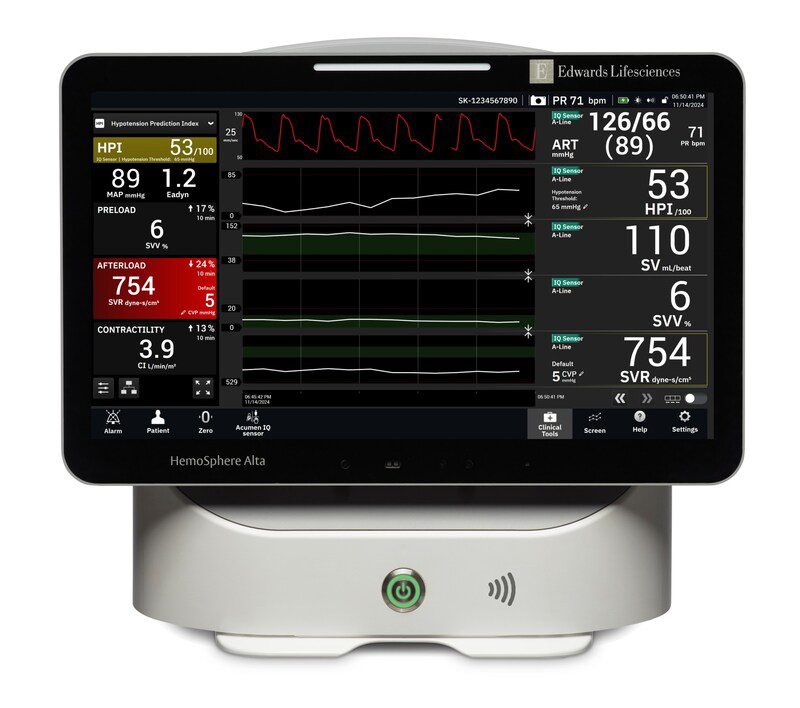
The HemoSphere Alta platform includes the Acumen Hypotension Prediction Index software that predicts when a patient could have a low blood pressure event — which has been demonstrated to reduce the depth, duration and severity of hypotension in several large multicenter studies, added Mythen.
HemoSphere Alta also introduces several advanced features that seem straight out of science fiction including voice and gesture control, enabling hands-free interaction in sterile environments.
Notes Mythen, “We’ve already traveled the journey from descriptive to predictive monitoring, and the next stage will involve increased integration between monitoring and therapy delivery systems. This could allow predictive algorithms to crosstalk with the therapy delivery devices, helping clinicians make more informed decisions and smooth out the delivery of the appropriate therapy.”
Advances in remote monitoring
In South Jersey, medical device company Rhythmedix is revolutionizing ambulatory cardiac monitoring. Founded in 2014, Rhythmedix employs 260 people and has monitored more than 2 million patients, according to Brian Pike, company president, COO and co-founder.
“Our company’s flagship product, RhythmStar, is a compact wearable device that transmits ECG [electrocardiogram, a test that measures the electrical activity of the heart] data via an embedded cellular radio to a 24/7 cloud-based monitoring center, eliminating the need for patients to use their own phones or carry extra devices,” he explained. “Our device enhances patient comfort, streamlines clinical workflows, and provides precise diagnostic results.”
The “innovative design and intuitive data platform of RhythmStar” distinguish it from other market offerings, he added, “making it a valuable tool for both patients and health care providers.”
Remote cardiac monitoring provided by devices like Rhythmedix are lifesavers because they enable early identification and diagnosis of cardiac arrhythmias, “which are more prevalent among older adults in the U.S.,” Pike said. “These systems can notify health care providers promptly when irregularities are detected, allowing for timely clinical responses and potentially reducing the time to identify critical events. Technologies like Rhythmedix allow clinicians to address heart health through proactive management, supporting accessible and efficient cardiac care for older adults.”
Rhythmedix’s location in Mount Laurel has helped propel growth, he noted. “The area’s strong network of health systems, hospitals, and cardiology offices provided valuable feedback during the initial product and service launch. We are currently preparing multiple new versions of the device for FDA review, which will further advance the technology and enhance patient comfort.”
Detecting attacks in real time
Other companies, like Eatontown-based Avertix, also focus on improving cardiac care. Avertix developed a heart attack warning device designed to provide early detection and real-time alerts for high-risk cardiac cases.
“The Guardian System is the first and only FDA-approved implantable device specifically designed for high-risk cardiac patients who have survived a heart attack and remain vulnerable to future events,” said Avertix President and CEO Tim Moran. “It detects silent or atypical heart attacks in real time and alerts patients to seek care, often before symptoms even appear.”
Unlike traditional monitors that simply collect data, “Guardian is proactive,” he added. “It has been shown to reduce the average time from symptom onset to emergency care by more than eightfold, from over 13 hours to just 90 minutes. That time savings is not just meaningful, it is life-changing — and can preserve heart muscle, improve outcomes and save lives. For physicians, it is a powerful tool. For patients, it offers peace of mind and a second chance.”
Avertix is not a one-trick pony, Moran noted. “We are building Guardian into a connected ecosystem that extends well beyond the implant,” he explained. “Our next-generation platform includes a patient-facing mobile app for real-time data, two-way communication with care teams, and even potential integration with emergency services like 911.”
The aim is to enhance remote monitoring, strengthen clinical decision-making, and “make the entire system more intuitive for patients and physicians alike,” according to Moran.
Before joining Avertix, Moran held C-suite and other executive positions at a number of medical device and other companies. “We are a lean, mission-driven team of experienced medtech operators,” he said. “Most of us have built and scaled companies before. Everyone at Avertix is here because they believe in the Guardian’s potential to save lives, and that shared sense of purpose is what drives us.”
He acknowledged that scaling a new category comes with challenges like reimbursement and market education. But Moran views them as opportunities to lead, noting that, “Every milestone we hit – FDA approval, CMS [Centers for Medicare & Medicaid Services] reimbursement, commercial traction – helps us shape a new standard in cardiac care.”
For Moran, medtech is more than just a job — it’s a calling. “We are solving one of the most dangerous and often overlooked challenges in cardiology, which is the critical time between symptom onset and treatment in high-risk patients,” he explains. “That window is where lives are lost and where the Guardian System delivers the most impact. We are not just delivering a product. We are establishing a new standard of care. Our clinical results are strong, reimbursement is expanding, and commercial momentum is accelerating.
“We are here to give patients a second chance, and we are just getting started.”
link
More Stories
Kidney care: the economics of innovation
UK Medical Device Trials Hit Record High as MHRA Accelerates Innovation in Neurotech and AI
AI-Driven Innovation Accelerates Tempus AI’s Expansion Across MedTech – February 20, 2026