





This study was done through primary and secondary sources. In-depth secondary research gathered insights into the knee treatment surgery industry. The findings, assumptions, and market size estimates were then validated through primary research. Both top-down and bottom-up approaches were used to determine the total market size. Then, market segmentation and data triangulation methods were applied to determine the sizes of segments and sub-segments of the knee replacement surgery market. The research process also involved analyzing industry trends, segmentation types, key players, competitive landscape, market dynamics, and initiatives of key companies.
Secondary Research
The secondary research phase involved analyzing various sources, including industry directories, databases (such as Bloomberg Businessweek, Factiva, and D&B Hoovers), white papers, company filings, annual reports, investor presentations, and SEC filings. This research was essential in collecting technical, commercial, and market-related insights into the knee replacement surgery products sector. It also assisted in knowing key market players, segment classifications, and industry trends. Moreover, secondary research helped track market developments, advanced technologies, and competitive positioning. A database of major industry players was compiled by reviewing paid and publicly available data sources. The market evaluation of orthopedic device providers was based on assessing their product portfolios, performance, and overall quality. Furthermore, secondary research provided critical insights into the industry’s value chain, the key market participants, and classifications from technological and market-driven perspectives.
Primary Research
During the primary research, cross sections of sources from the demand and supply sides were interviewed to gather qualitative and quantitative information for this report. On the supply side, primary sources included industry players such as CEOs, vice presidents, marketing and sales directors, technology and innovation directors, and other key executives from leading companies and organizations in the knee replacement surgery industry. Demand-side sources comprised hospitals, ambulatory surgical centers, and orthopedic clinics. Primary research was conducted to authenticate market segments, monitor key players, and understand market trends. Following market engineering, which included calculation in statistics, segmentation analysis, estimation of the market, forecasting, and data triangulation, primary research was conducted to verify the key information.
A breakdown of the primary respondents is provided below:
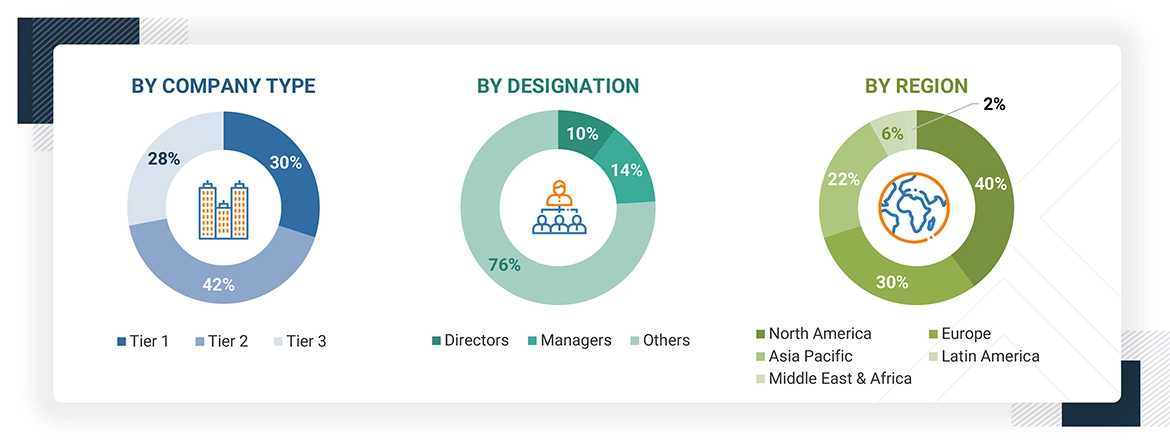
*Others include sales managers, marketing managers, business development managers, product managers, distributors, and suppliers.
Note: Companies are classified into tiers based on their total revenue. As of 2023, Tier 1 = >USD 2 billion, Tier 2 = USD 50 million to USD 2 billion, and Tier 3 = < USD 50 million.
To know about the assumptions considered for the study, download the pdf brochure
Market Size Estimation
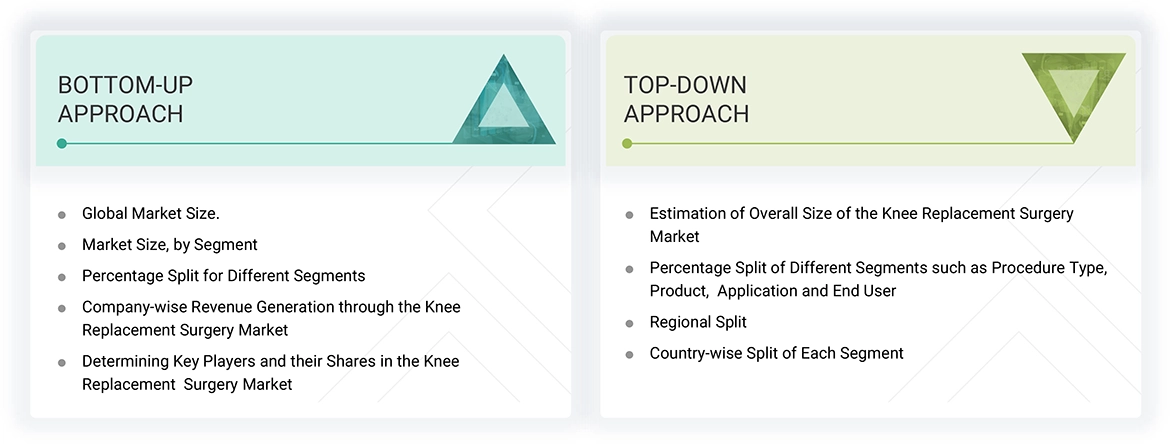
Both top-down and bottom-up approaches were used to estimate and validate the total size of the lab consumable market. These methods were also used extensively to estimate the size of various segments in the knee replacement surgery market.
Revenue share analysis was employed with the leading players to determine the size of the global Knee replacement surgery market. In this case, key players in the market have been identified, with their knee replacement surgery products business revenues determined through various insights gathered during the primary and secondary research phases. Secondary research included the study of top market players’ annual and financial reports. On the other hand, primary research incorporated in-depth interviews with key opinion leaders, particularly chief executive officers, directors, and key marketing executives.
The research methodology used to estimate the market size includes the following:
Data Triangulation
After determining the overall market size through the estimation process, the global knee replacement surgery market was categorized into segments. Data triangulation methods were utilized to finalize the market engineering process and obtain precise statistics for each segment. This approach involved analyzing multiple factors and trends from both the demand and supply perspectives. Furthermore, the knee replacement surgery market was verified using a combination of top-down and bottom-up approaches.
Market Definition
Knee surgical interventions utilize an array of devices, including diverse knee implants, orthopedic braces, and supportive products, as well as orthobiologics designed for the stabilization and management of conditions such as osteoarthritis, rheumatoid arthritis, neoplasms, and degenerative diseases, among other clinical applications.
Stakeholders
- Knee Replacement Surgery Product Manufacturing Companies
- Product Distributors and Channel Partners
- Hospitals and Surgical Centers
- Orthopedic Clinics
- Ambulatory Care Centers
- Sports Institutes and Organizations
- Contract Manufacturers and Third-party Suppliers
- Research Laboratories and Academic Institutes
- Clinical Research Organizations (CROs)
- Government and Non-governmental Regulatory Authorities
- Market Research and Consulting Firms
Report Objectives
- To define, describe, and forecast the global knee replacement surgery market based on product, procedure type, application, end user, and region
- To provide detailed information regarding the major factors influencing the market growth (drivers, restraints, opportunities, and challenges) along with the current trends
- To strategically analyze micromarkets1 with respect to their individual growth trends, future prospects, and contributions to the total market
- To analyze opportunities in the market for stakeholders and provide details of the competitive landscape for market leaders
- To forecast the revenue of the market segments for five regions: North America (US and Canada), Europe (Germany, France, UK, Italy, Spain, and Rest of Europe), the Asia Pacific (China, Japan, India, South Korea, Australia, and Rest of Asia Pacific), Latin America (Brazil, Mexico, and Rest of Latin America), and the Middle East & Africa
- To profile the key players and comprehensively analyze their market shares and core competencies2
- To track and analyze competitive developments in the knee replacement surgery market, such as acquisitions, product launches, expansions, agreements, joint ventures, alliances, and collaborations
link
More Stories
Median Arcuate Ligament Syndrome | Orlando surgeon explains signs, symptoms and treatment
Gyder Surgical announces first commercial surgical cases in the United States performed by Dr. Paul M. Lombardi, M.D., at the Tri-County Orthopedics’ Joint Replacement Institute outpatient center
Bunion Surgery Market Get Facts About Business Strategies 2026 to 2031: Medi-tech Insights