



Visiting a production center, factory, or design space is always a fantastic experience. Seeing how the components and devices MPO covers are developed and manufactured in their real environment provides valuable insight into the processes and challenges involved. It offers a look “behind the curtain” of what’s happening in a space we often only discuss with those living it day-to-day.
As such, when an organization offers to allow such a view of a medtech development and manufacturing region, it’s difficult to turn it down. Unfortunately, that’s often the case as the stars need to align with other travel, print deadlines, and additional obligations. However, during the fall of last year, it was made possible thanks to IDA Ireland and a number of cooperating organizations who hosted me for a whirlwind trip through three cities in Ireland—Cork, Limerick, and Galway. During this brief journey, we made several stops at locations that forward the country’s transformation from a manufacturing hub to a more well-rounded region that provides vital resources for medtech innovation.
Tyndall National Institute
A true hub for creativity and development, the Tyndall Institute brings together a variety of critical sectors with the mission of forwarding innovation. With researchers, engineers, and support staff available to assist the graduate students, enterprise clients, and industry researchers-in-residence, the Institute provides a space for continued exploration of technology to be leveraged across numerous sectors, including medtech.
Tyndall Institute’s primary focus is on electronic technologies and advancements. Its core research areas are photonics, micro-nano electronics, and systems integration. This encompasses sensors, semiconductor wafer fabrication, cloud-based hardware and software, artificial intelligence, cybersecurity, and more. The areas of study span from atoms through circuits and subsystems to full systems integration.
I had the pleasure of meeting with Carlo Webster, the Institute’s senior strategic business executive, who provided a comprehensive tour of the facility. He pointed out the facility’s meeting spaces and work areas where many notable achievements have been conceived. The Institute played host to a number of accomplishments, including the world’s brightest LED, the first implantable radiation sensor, the first junctionless transistor, and the first magnetics-on-silicon for power supply on chip. The Institute also serves as a fantastic talent pipeline for industry, as researchers have gone on to positions at Intel, Deloitte, Stryker, and Rockley Photonics.
In addition to my conversation with Webster and the tour of the facility, I was also honored to have the opportunity to meet with several “residents” of the institute who were entrenched in their own projects.
HyperFi (Hyperpath)—According to the project’s lead researcher, “HyperFi is a connectivity module that uses multiple network connections simultaneously to make connectivity more resilient and secure.” The technology is agnostic with regard to the pathway used. It can leverage Wi-Fi, cellular, and smartphone hotspots to deliver data to the desired destination. For critical medical device data that needs to be provided without fail, such as for patient monitoring applications, the technology would be invaluable, especially when patients are on the go or in remote locations. It can also organize large data sets into smaller packets and send them across multiple channels to ensure the complete package arrives safely.
E-CAP—This project involved the development of an eHealth capsule for digestive disease diagnostics and therapy. Specifically, E-CAP’s focus is on gastroesophageal reflux disease (GERD), which affects approximately 1.2 billion people globally at a cost of approximately $12,000 per patient annually. Connecting to the patient’s smartphone via Bluetooth LTE, the E-CAP device provides comprehensive feedback over an approximately 48-hour period to help direct and personalize the treatment plan. With treatment failures occurring about 40% of the time, this targeted approach to tailor the plan for each patient specifically is intended to significantly reduce that figure.
pHetal Safe—Another project sought to improve fetal monitoring during labor, as it was noted 1.2 million babies die each year from a lack of oxygen during childbirth. Current solutions, such as a CTG monitor, are accompanied by a variety of challenges, resulting in subpar clinical results. With pHetal Safe, a small sensor is placed on the baby’s head while still in the womb near the start of the delivery process. The device eliminates false positive alerts and improves the detection and diagnosis of fetal hypoxia and distress by measuring continuous fetal lactate levels.
This brief look at the Institute and several of the projects being developed there was enough to impress upon me the value of such a research center. Additionally, health is just one focus of the facility. There are projects dedicated to other sectors as well—information and communication technology, energy, food and agriculture, defense, Industry 4.0, automotive, and aerospace.
University of Limerick
A notable aspect of the trip at all the meeting locations in Ireland was the positive attitude and enthusiasm with which so many spoke of their projects or work. Not only were the people with whom I met excited to be involved in such important research, but it was clear just how much they enjoyed it. While being exposed to the development lifecycle was incredibly interesting, hearing about it directly from those involved in such an enthusiastic manner made it even more pleasing.
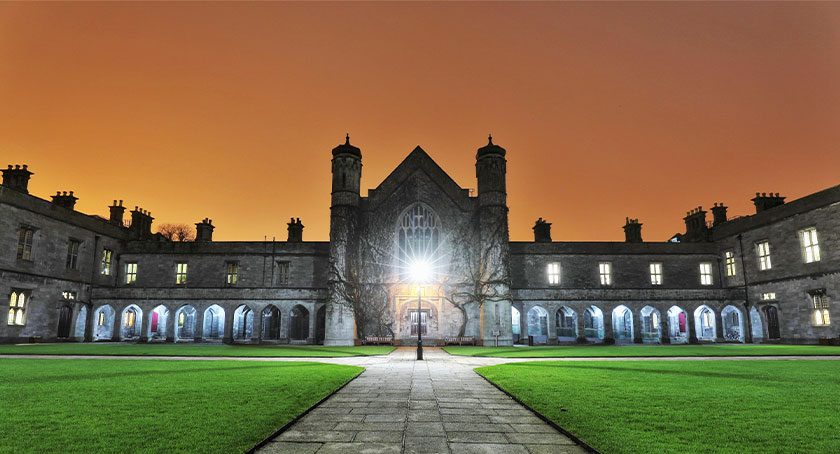
This attitude was perhaps never better reflected than when I met with those at the University of Limerick. The meeting room was filled with professors and others who were employed at the institution, on hand to discuss important research projects and their relationship to medtech. These few represented the approximately 1,000 staff members who were involved with research at the University. The School of Engineering maintains a focus on biomedical specifically (in addition to other engineering areas), and the University also enjoys a research-centric relationship with UL.
During this session, I was introduced to a number of key personnel and segments of the University that provided a look at the learning taking place. More importantly, the school’s approach relied heavily on real-world dynamics as part of the experience, including some programs where time spent with a business was part of the curriculum.
During this session, I was introduced to Professor Leonard O’Sullivan, the director of the Rapid Innovation Unit. With a Ph.D. in ergonomics and human factors, he guides the unit to focus on resolving clinical challenges for which there are no current or adequate solutions available. I was provided examples of success stories, including a crutch developed for an arm amputee, a custom eye patch, and bespoke breast prostheses.
The Stokes Laboratories for Fluid Dynamics is home to research on microfluidics for molecular diagnostics. Its most public achievement was the sale of Stokes Bio for $50 million to Life Technologies, a U.S. firm, in 2010. But the entity also boasts the spin-out of Altratech, a company co-founded by Dr. Tara Dalton that is producing a device for molecular detection in a completely new way. Another project, branded as Tango, involves developing a method to measure T-cell response.
While Immersive Software Engineering (ISE) is taking place in the Department of Computer Science and Information Systems, the life sciences industry’s increasing demand for this type of talent involves several companies. BD, J&J, Boston Scientific, Carelon, and Lilly are all named partners, and three of the organizations are involved as members of the Industry Advisory Board. This program thrusts students into action with firms to help solve real-world problems. Half of the students’ time is spent with residency partners through paid placements. It enables a master’s degree to be obtained in four years.
Given the tremendous success of the ISE program, the University has established a similar model for the biopharmaceutical sector. While iBio doesn’t specifically serve the medical devices industry, it does demonstrate a rethinking of the academic pathway for students seeking to gain real-world experience alongside classroom learning to be better suited to address the needs of companies.
The University is honored to provide a labor supply line to industry and takes responsibility for nurturing an innovative mindset seriously. The programs I was introduced to all seemed to offer a deeper dive than the traditional internship experience, more so molding students into creative thinkers for the medical device manufacturing space, along with many other industries.
Digital Manufacturing Ireland
Innovation doesn’t just happen. It needs the right personnel, environment, leadership, experience, drive, and technology. It is with regard to this last factor that one of the most unique visits took place during my visit to Ireland.
Digital Manufacturing Ireland (DMI) is a national organization that facilitates access to Industry 4.0 elements for Ireland-based manufacturing firms, enabling them to gain insights from an unbiased group of experts who can evaluate needs and make recommendations. It essentially serves as an Industry 4.0 consultant that can offer advice on the adoption, integration, and acquisition of the necessary tools required for each specific case. At the DMI facility, company representatives can have a custom digital manufacturing line created from various manufacturers that best suits their needs for artificial intelligence, robotics, automation, and software.
Unlike a more commonly known automation integrator, which may sound similar to the services DMI offers, this organization is brand agnostic. They don’t have preferred vendors for equipment, technologies, or software. Instead, they are interested in revealing the best solutions in terms of digital manufacturing needs for an Ireland-based manufacturing firm. In some cases, DMI will recommend training rather than a capital investment, which may not be necessary. Further, when it comes time for a capital expenditure or investment in technology, DMI steps away from the process, allowing its client and the equipment vendors to negotiate the specific terms, such as price and value-added services.
Upon the opening of DMI in March 2023, it was announced the organization had already established a strategic partnership with Edwards Lifesciences to enhance the medtech organization’s sites in Limerick and Clare. Andrew Walls, plant general manager of Edwards Lifesciences in Limerick, explained, “Edwards Lifesciences is proud to be partnering with Digital Manufacturing Ireland, to support the development and delivery of Edwards’ digital transformation programme. We will collectively be working across the three pillars of technology, human-centric manufacturing, and supply chain operations in order to advance the digital capabilities of our operations and workforce.”
More recently, it was just announced in May 2025 that DMI would serve as host to a Vision Accelerator at its headquarters. This facility would promote and inform on the use of machine vision. Like DMI, the Accelerator will be staffed by a dedicated team of experts who can offer advice to companies in the center’s open, collaborative environment.
Tommy Brennan, cognitive manufacturing manager at DMI, said, “This initiative marks a significant step forward in Ireland’s digital manufacturing journey. The Vision Accelerator will also focus on training and upskilling talent, ensuring that Ireland remains a leader in the integration of machine vision technology across sectors, including food and beverage, life sciences, and technology.”
“By supporting organizations to develop, understand, and deploy machine vision technologies, this initiative from DMI will significantly impact manufacturing in Ireland and beyond. DMI is fulfilling its mission of enabling manufacturers to access, adopt, and accelerate new digital technologies that drive future competitiveness,” added Rachel Shelly, global head of life sciences and food at IDA Ireland.
University of Galway
At the University of Galway, the mindset resembled that of those at the University of Limerick. That is, they are focused on determining how they can best help provide what’s needed by the industries their students are seeking to serve. This happens through several methods, including the establishment of research centers, partnering with industry, and a unique program called Bioinnovate.
The Bioinnovate program promotes the establishment of a realistic business model that seeks to address a real-world clinical need. It places students from three diverse disciplines—business, clinical, and engineering—together to conceptualize a business plan that would bring a medical device to market to resolve a healthcare challenge. It is well-supported by academia, industry, and clinical professionals, as mentors are sourced from all three sectors. Due in part to this program, the University of Galway spun out 16 medtech startups between 2010 and 2020, which was more than any other Irish university during that timeframe.
Conclusion
The medtech world is well aware of Ireland’s offerings as a hub for medical device manufacturing. That’s been clear since Medtronic relocated its headquarters there more than a decade ago. However, what’s not as well-known is how far along the country has come in serving as an innovation center for the industry. With support across multiple sectors, from government to academia, it is clear Ireland provides the necessary environment to ensure creativity, research, and development thrive. As more companies seek to investigate the situation further, interest and opportunity there will only continue to grow.
link
More Stories
Kidney care: the economics of innovation
UK Medical Device Trials Hit Record High as MHRA Accelerates Innovation in Neurotech and AI
AI-Driven Innovation Accelerates Tempus AI’s Expansion Across MedTech – February 20, 2026