





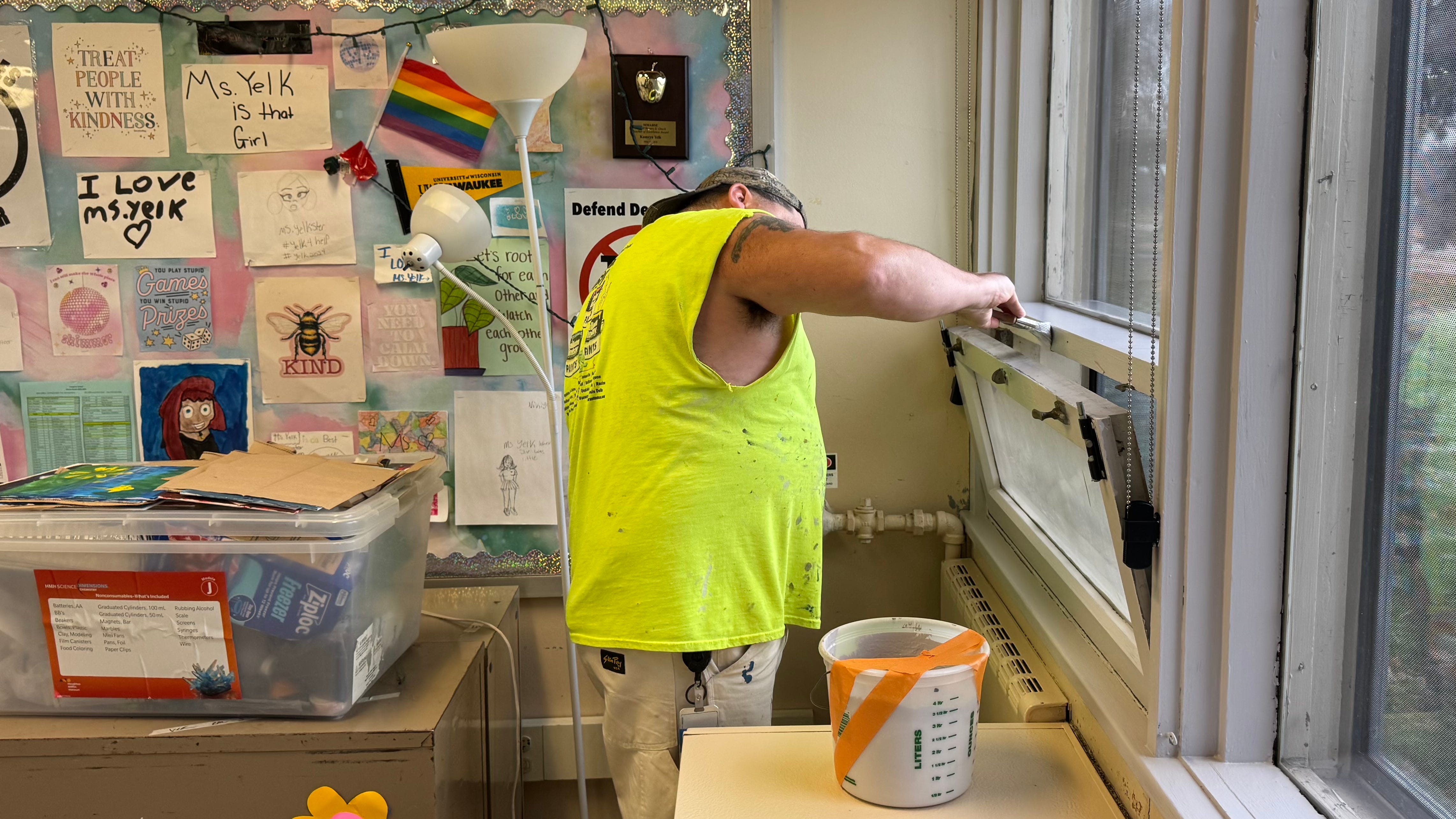

MPS wraps lead-paint cleanup work at 100 schools
About 100 Milwaukee Public Schools buildings were cleared of lead paint hazards. The district will have ongoing monitoring and maintenance.
- The Milwaukee Health Department published its latest Community Health Assessment in early January.
- The assessment identifies chronic disease, maternal and child health, mental health, substance use and violence and injury prevention as priority health issues.
- Health outcomes are strongly tied to income, education and housing, health department leaders said.
A new assessment from the Milwaukee Health Department depicts the many challenges the city faces to improve its residents’ well-being – and the major role that non-medical factors play in that work.
The health department will focus in the coming years on five priority health concerns – chronic disease, maternal and child health, mental health, substance use disorder, and violence and injury prevention.
They are each stubborn issues for which the path to improvement is long, and heavily tied to income and education, said Dominique Hyatt-Oates, deputy commissioner of Policy, Innovation and Equity at the health department.
“We often think of health care as going to the doctor, having an appointment – the very clinical aspects,” Hyatt-Oates said. The assessment is a reminder that “outside of that sphere, there are needs of our community,” she said.
Local health departments are required by law to publish a Community Health Assessment once every five years. The city last published one in 2022 and will publish them on a three-year schedule moving forward.
The assessment draws on quantitative data collected by the health department and other health care entities, as well as focus group interviews and survey responses from about 3,400 residents. In the coming weeks and months, health department staffers plan to distribute it throughout the community and discuss it with residents, said Ali Tahler-Reed, the health department’s director of data and evaluation.
Here’s what to know about its findings.
Residents are dying early from homicides, overdoses, car crashes
Accidents and homicides remain the leading causes of death for Milwaukee residents ages 1-44.
Although the health assessment only contains homicide data through 2023, city leaders recently expressed concern about a year-over-year increase from 2024 to 2025, from 132 to 142. Homicides are the main driver of firearm deaths in Milwaukee, according to the assessment, in contrast with suicides in many parts of the country.
Between 2017 and 2023, the yearly number of accidental fatal injuries across the city grew about 60%. That growth was driven largely by poisonings, which include overdoses. Today, overdoses cause more accidental deaths in Milwaukee than falls, firearms and car crashes combined, even though they are generally trending downward statewide.
Reckless driving also remains a major problem in Milwaukee. Traffic deaths increased 45% between 2014 and 2024, and serious injuries from car crashes nearly doubled.
Milwaukee is a young city: Residents ages 1-44 make up 60% of the city’s population, and nearly one-third of the total population is under 20.
“We have time to influence these folks,” Tahler-Reed said, and double down on strategies to keep them safe, such as creating third spaces for youth to safely gather.
Milwaukee’s infant mortality rate remains among nation’s worst
The city’s long-standing problem of babies dying before their first birthday has seen little improvement, according to the health assessment, particularly for Black residents.
In 2023, the latest year for which data is available, Milwaukee’s infant mortality rate was 9.37 deaths for every 1,000 live births, the fifth highest of U.S. cities. Black infants account for about 38% of the city’s births but make up two-thirds of all infant deaths.
City leaders, health systems and community groups have poured millions of dollars into trying to fix the issue and are still doing so. Hyatt-Oates said the health department is convening a new strategic planning process to tackle the issue anew. Its first meeting was Jan. 15.
The assessment notes that a number of policies used in other states to improve maternal and infant health, such as postpartum Medicaid expansion and reimbursement for doula care, have not been adopted in Wisconsin.
Poor housing quality, environmental hazards lead to health problems
The condition of a person’s home or apartment has a heavy influence on their health – a finding that shows up often in the city’s assessment.
Milwaukee’s lead crisis is well known. Exposure to lead-based paint has sickened children across the city, especially in neighborhoods where residents lack the financial resources to address the problem.
But there are other ways that housing impacts health, Tahler-Reed said, pointing to mold growth after Milwaukee’s historic flood last August as one example.
The health assessment found that some residents, particularly refugees, accept subpar housing conditions because they need a roof over their heads, Tahler-Reed said. That has consequences.
“It can affect years of life (lost). It can affect chronic disease. It can affect your children’s education,” she said.
Environmental exposures inside and outside the home can worsen asthma, another stubborn problem in Milwaukee, which has the highest rates of emergency department visits for asthma attacks in the country. The burden of asthma is far higher in predominantly Black neighborhoods than predominantly White ones, especially in those with old housing stock and nearby industrial facilities that emit pollutants.
Heart disease is city’s top cause of death across gender, race
Heart disease was the top cause of death in Milwaukee annually between 2017 and 2023, the most recent data available. The city isn’t alone – it is also the top cause of death statewide and nationally.
That holds true across gender and race, but significant disparities still exist. Heart disease death rates are nearly one and a half times higher among Black residents than their White or Hispanic counterparts, according to the assessment. Emergency room visit rates for heart failure were almost four times higher in 2024 for Black residents than White residents.
Inadequate access to health care and healthy food, as well as chronic stress over poverty, violence or unstable housing, contributes to those disparities, according to the assessment.
Nearly 1 in 5 adults report ‘frequent mental distress’
Almost 20% of Milwaukee adults said they experienced frequent mental distress in 2023, which is defined as poor mental health for 14 or more days in the past month. The assessment draws this data from the Big Cities Health Coalition, a consortium of health department leaders in the country’s most populous cities.
Between 2020 and 2024, there were about 1,700 emergency room visits for mental health issues per 100,000 residents in Milwaukee, according to the assessment.
In interviews and focus groups conducted for the city’s assessment, residents said fears of gun violence and reckless driving impact their mental health.
Madeline Heim covers health and the environment for the Milwaukee Journal Sentinel. Contact her at 920-996-7266 or [email protected].
link
More Stories
Staff crunch cripples 64 FRUs, raising concerns over maternal and child health
Council seeks way to reduce maternal and infant health disparities
Leaders Prioritise Health Sovereignty and Women’s, Children’s and Adolescents’ Health at the 39th AU Summit