




Thursday, Dec. 11, 2025 | 2 a.m.
Editor’s note: Este artículo está traducido al español.
Dr. Kornelis Poelstra is pioneering the future of spinal surgery with robotics — and he’s doing it right here in Southern Nevada.
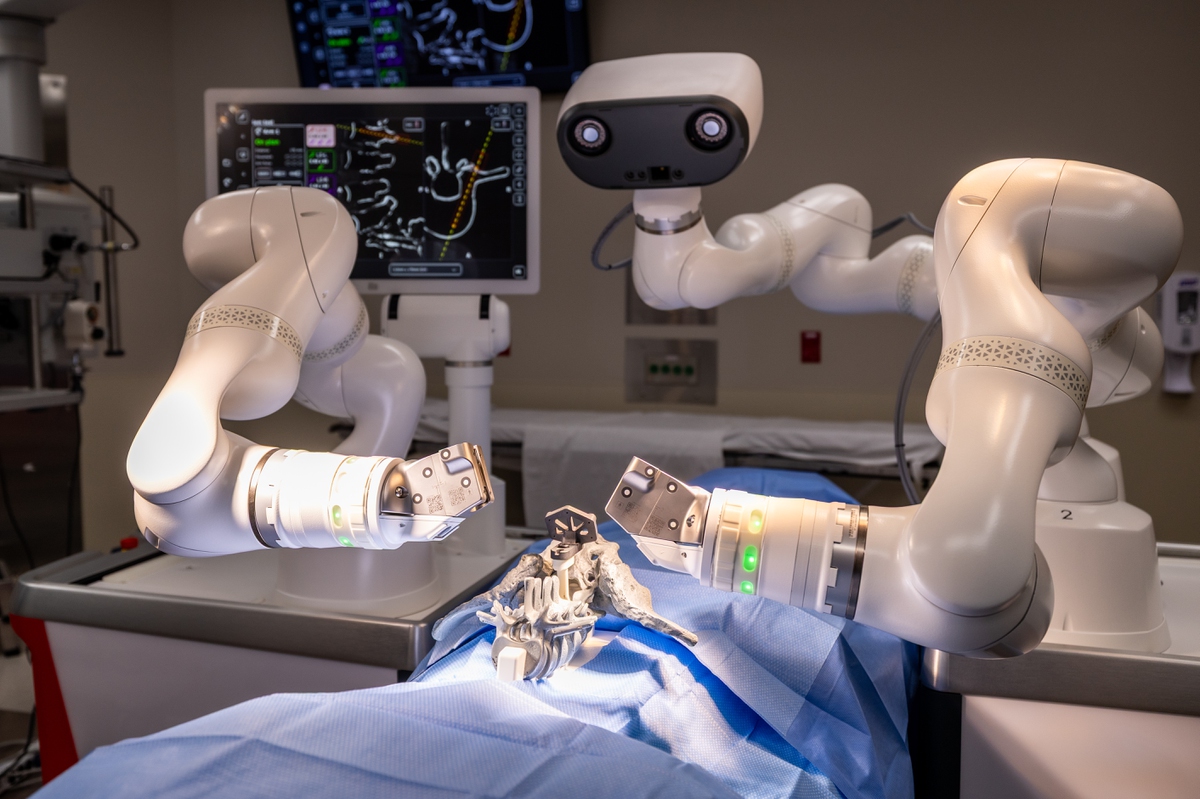
The orthopedic surgeon is believed to be the world’s only operator of the Dynamis Robotic Surgical System, a revolutionary multiarm robot designed specifically for hard tissue procedures like bone surgery. At Southern Hills Hospital, he has performed more robotic spine surgeries than any surgeon globally, drawing patients from across the country.
“There’s nobody else who has this robot,” Poelstra said. “I have patients traveling from the East Coast, Florida and Texas for these procedures. I feel very blessed and humbled to have brought this technology here as the first in the world.”
He added: “The joke was always that the best hospital in Vegas is (Harry Reid International) Airport so you can get out of here, but now, Harry Reid Airport should be a place where people come and enjoy the quality of care that we can deliver like nobody else in the world.”
While spinal robotics has existed for at least 15 years, the field took a leap forward a decade ago when experts began developing robotic arms to assist surgeons in the operating room. Soft tissue surgical robots like the Da Vinci series revolutionized procedures involving muscles, organs and connective tissues — but they couldn’t be used on bones and joints.
The Dynamis system fills this critical gap, bringing robotic precision to orthopedic and spinal procedures.
The technology from that era evolved into the Mazor X, the first single-arm robot capable of assisting with spinal surgery. It sparked hope that robots could one day face the unique challenges of hard tissue operations, Poelstra explained.
But significant obstacles remained.
The robot can only perform semiautonomous tasks if the target is completely immobile, Poelstra said. With just one arm, there’s nothing to hold the bone or joint stable enough for the robot to complete its task. If a robot tries to cut into bone without stabilization, even the smallest movement could harm the patient.
That’s where the Dynamis system’s multiple arms make all the difference. A multiarm robot employs one “limb” to keep the spine immobile while the other arm can “do things effectively to the spine, such as putting in screws (or) drilling away bone,” Poelstra said.
Switzerland-based LEM Surgical, the developers of the Dynamis, announced in April that they had received clearance from the U.S. Food and Drug Administration for their multiarm, hard tissue surgical robot. LEM Surgical said in a statement the invention is “designed to enhance accuracy and control during spine surgeries.”
It features three robotic arms — two for surgical guidance and one for optical navigation, all packed into a single car that can partially fit under a surgical table. LEM Surgical added that the Dynamis “supports a wide range of surgical instruments … enhancing compatibility and hospital workflow efficiency.”
The first clinical procedures in the U.S. with the Dynamis were completed by Poelstra at the end of October, which LEM Surgical considers a “monumental achievement” and “significant leap forward” in the effort to “transform hard tissue surgery.”
Since then, Poelstra has completed “almost a dozen cases” with the Dynamis and said he was “very excited to see where the opportunities” with multiarmed robots will go with making surgeries “more predictable, safer, and ultimately faster with (a) less invasive technique” on patients.
“This operation and new technology, coupled with our team’s incredible skill, are transforming what’s possible for patients in our community,” said Alexis Mussi, CEO of Southern Hills Hospital, in a news release. “We are honored to be the first hospital in the world to implement this multiarm robotic platform and to continue advancing the standard of spine surgery.”
High-tech staff
Southern Hills has about 10 other medical robots to assist with minimally invasive soft tissue procedures, pulmonary matters and orthopedic cases, said Jason Desai, the hospital’s chief operating officer.
“It is a significant investment that we’re making to better the care here in Las Vegas,” Desai said.
He added that every robot is different depending on what abilities they have and how much they will be using it in the hospital.
“The goal with all our robotic platforms is really to ultimately get those patients on to their next level of care as quickly as we can so they can fully recover,” Desai said. “The surgery is the big part of it, obviously, but the recovery comes afterwards, and the more we can use that technology and use that minimally invasive approach to those surgical procedures, that will only benefit the patient.”
Southern Hills and MountainView hospitals were recognized last month for their hospital safety by the Leapfrog Group, a national nonprofit watchdog that grades hospitals based on their prevention of medical errors, infections and injuries.
The two Las Vegas hospitals were given an “A,” the highest level of patient safety performance — a feat that was due in part to their fleet of medical robots and clinicians along with the training HCA Healthcare offers its medical professionals, said Dr. Saba Habis, division vice president of Graduate Medical Education.
HCA Healthcare operates over 325 Graduate Medical Education programs to more than 5,300 residents and 360 fellows, with almost 20 of them being offered in Las Vegas.
During these training sessions, medical residents and fellows learn, among other things, medical professionalism, etiquette and skills necessary for their specific area of study.
Habis explained that HCA Healthcare “always (has) their eyes on the future,” and they’re already helping train graduates in robotic surgery and cutting-edge technology “so they can meet the moment upon graduation and not be practicing antiquated methods of medicine.”
It starts from Day 1 of their training, Habis added. Once the company decides they have the ability to provide a certain type of training, the curriculum is already considering how to integrate this cutting-edge technology.
Habis said HCA Healthcare has invested millions of dollars in state-of-the-art simulation laboratories, like the ones at MountainView, Southern Hills, and the Galen School of Nursing, where all medical professionals can practice their skills or train for new ones using advanced medical technologies.
Training can be done with a robotic console mimicking the ones they’d use during actual operations in one of the hospitals, or even on lifelike manikins that can sweat, make sounds, and replicate illnesses that real patients experience when they walk into the hospital’s doors. It’s “really crucial” that students in the Graduate Medical Education programs get that practice in a safe environment where feedback can be given so when they meet with real patients later in their careers, they’re efficient, accurate and up to date on the most modern medical practices, Habis said.
He added that the training program has also “improved our competitive advantage in the recruiting effort” and flattened the learning curve so graduates are less likely to be overwhelmed by the medical technology used at HCA Healthcare facilities once they enter the field.
“What we’re trying to accomplish here is first, preparing for where the future is going to be (and) the second is that accuracy and patient safety is paramount,” Habis said. “No patient should stay in the hospital longer than they need, and when you do it all minimally invasive and with the utmost safety standard, then the patient will be with their family back home much sooner, so those are all part of the drive and then the robot, or any other sim, or any other manikin are the tools to get that big vision accomplished.”
[email protected] / 702-948-7854 / @gracedarocha
link
More Stories
Median Arcuate Ligament Syndrome | Orlando surgeon explains signs, symptoms and treatment
Gyder Surgical announces first commercial surgical cases in the United States performed by Dr. Paul M. Lombardi, M.D., at the Tri-County Orthopedics’ Joint Replacement Institute outpatient center
Bunion Surgery Market Get Facts About Business Strategies 2026 to 2031: Medi-tech Insights