



BOLD RESEARCH. REAL IMPACT.
READ MORE STORIES OF IMPACT
For patients facing high-risk surgery, the difference between success and serious
complications can come down to the finest details of their anatomy.
That is why surgeons at USF Health and Tampa General Hospital are turning to an unexpected
tool before they ever operate: 3D-printed replicas of their patients’ own organs.
Created from digital medical scans, these models allow physicians to examine and rehearse
procedures on an exact physical copy of what they will encounter in the operating
room.
Inside the cutting-edge Tampa General Hospital–USF Health 3D Medical Visualization
and Printing Lab, a bank of specialized printers builds precision replicas of aortas,
kidneys, jawbones and other body parts layer by layer. The process transforms data
into a powerful physical form of personalized medicine that helps physicians plan
and operate more safely.
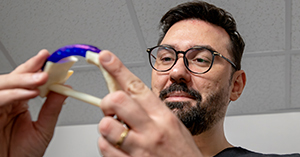
“We’re able to materialize what surgeons only see on screens,” said Devid Zille, director
of the lab and assistant professor of radiology in the USF Health Morsani College
of Medicine. “Holding the model in their hands, they can rotate and see if there are
any difficulties that they will encounter during surgery.”
Because every human body is different, small anatomical variations can have a significant
impact during complex procedures. Access to patient-specific modeling allows surgeons
to map out a clear strategy and anticipate potential risks. For patients, this additional
level of preparation often means shorter surgeries, fewer complications and better
outcomes.
Few physicians recognize that value better than Dr. Fadi Matar, director of the TGH
Heart & Vascular Institute’s Research & Innovation Center and professor and chief
of cardiology in the USF Health Morsani College of Medicine.
Matar began exploring 3D printing about a decade ago while performing high-risk structural
cardiac interventions. He has found the models particularly valuable in helping anticipate
one of the most dangerous risks in valve replacement procedures: coronary artery occlusion,
which occurs when the supply of blood to the heart is blocked.
By reviewing a 3D-printed model of a patient’s heart, Matar can determine whether
additional protective steps are needed before surgery.
“With these models, we can actually see how a patient’s coronary arteries relate to
the valve we’re about to implant,” Matar said. “We are lucky here at USF and TGH to
have all those tools available to us as physicians.”
In addition to its impact on patient care, the 3D Innovations Lab is also reshaping
health education and how future physicians are trained.
At the USF Health Center for Advanced Medical Learning and Simulation (CAMLS), Melissa
Milner, director of clinical simulation, developed fetal models to prepare surgeons
for delicate and complex medical procedures such as spina bifida.
Spina bifida, a birth defect where the spine and spinal cord do not develop properly,
can result in paralysis and significant physical disabilities. Surgery before birth
can dramatically improve outcomes and quality of life for patients, but the procedure
requires extraordinary precision.
Milner’s team had already been creating silicone fetal models when Zille joined the
3D Innovations Lab, and their partnership evolved.
Zille’s 3D printing expertise provided a solution to a challenge Milner faced: making
the spinal defect appear at skin level to simulate actual surgical conditions. Rather
than manually cutting each model, Zille designed and 3D-printed a custom cradle for
the back of each fetus. The cradle allows the defect insert to be swapped between
models, so surgeons can practice repeatedly without damaging the fetus model itself.
The result is a lifelike training model that gives medical students and practicing
surgeons the opportunity to perfect their skills before performing high-stakes procedures
on real patients.
“With the tactile feel, it’s much easier for surgeons to pre-plan cases and visually
recognize what they’ll be approaching on the surgical field,” said Zille. For Milner,
her partnership with the TGH–USF Health Innovations Lab only scratches the surface
of what the technology can do, and she believes it will increasingly impact how physicians
provide care in the future.
“The uses of this 3D print lab are endless,” Milner said.
link
More Stories
Median Arcuate Ligament Syndrome | Orlando surgeon explains signs, symptoms and treatment
Gyder Surgical announces first commercial surgical cases in the United States performed by Dr. Paul M. Lombardi, M.D., at the Tri-County Orthopedics’ Joint Replacement Institute outpatient center
Bunion Surgery Market Get Facts About Business Strategies 2026 to 2031: Medi-tech Insights